Friday, May 1, 2015

Backpacking: Things you should do when visiting Ilocos Norte/Sur, Philippines

Welcome to Travel+Experiment!   

Ilocos is divided into two regions; the Ilocos Sur and Ilocos Norte. The province offers a numerous tourist attractions both for local and foreign. During summer seasons, visitors travel to the beaches, historical landmarks with the welcoming lovely people of Ilocos. There are few dishes that I highly recommend to try before leaving Ilocos are; (pinakbet, igado,dinakdakan, poqui-poqui, deep-fried pork belly called bagnet and the native sausage, longganisa).
Ilocos Norte is noted for being the birthplace of former President Ferdinand E. Marcos, who led an authoritarian rule over the country. There are numerous environmentally power plants projects that include the 25Megawatt wind farm for its energy usage. One of the benefits of the power plant is Fort Ilocandia, an upper class hotel and beach resorts, and Pagudpud. Its capital is Laoag City and is located at the northwest corner of Luzon Island, bordering Cagayan and Apayao to the ewqast, and Abra and Ilocos Sur to the south. Ilocos Norte faces the South China Sea to the west and the Luzon Strait to the north.
While Ilocos Sur Province, it is popularly known for its heritage village of the Philippines which is located in Vigan. The historic city of Vigan was inscribed in UNESCO’s World Heritage List in November 1999. Vigan is the best preserved example of a planned Spanish colonial town in Asia. Viva Vigan Arts and Industry Festival is held every first week of May featuring painting and product exhibits, a Calesa parade, and other cultural activities. Its capital also is Vigan City and is bordered by Ilocos Norte and Abra to the north, Mountain Province to the east, La Union and Benguet to the south, and the South China Sea to the west.

Activities and attractions must see in Ilocos.

Destination: Introducing Ilocos!

How to get there:
There are a lot of tour packages available going to Ilocos.  Mostly the package offers “Laoag, Vigan, Pagudpud Tour for 3 Days and 2 Nights” with hotels and resorts information; also a sample itinerary that you can customized in your tour details. The minimum cost is 3,200 pesos per person. 

By air

The nearest airport is the Laoag International Airport, in the nearby province of Ilocos Norte. The airport caters to both international and domestic flights. The national carrier, Philippines Airlines, have four flights each week to Laoag. It’s a 45-minute flight from Manila to Laoag City, Ilocos Norte. A bus trip from the airport to Ilocos Sur would take more than an hour.

Sample Package Inclusions:

o    2 days/ 1 night Standard aircon room accommodation in Laoag – Budget/ Standard/ Highend
o    2 days/ 1 night Standard aircon room accommodation in Pagudpud – Budget/ Standard/ Highend
o    Daily set breakfast ( starting on Day 2)
o    Complete Ilocandia Tours (Laoag, Vigan, Pagudpud)
o    Roundtrip private aircon van transportation ( Airport – Laoag/ Pagudpud/ Vigan – Airport)
o    Driver
o    Entrance fees

Excluded:

o    Roundtrip Airfare
o    Other meals that are not stated above
o    Tour guide ( upon request / P1,500 per guide per day)


By land


Going to Ilocos from Manila by van normally takes 10-12 hours away drive. Buses like Rabbit, Partas, and Dominion may take longer trips depending on the stop-overs. The bus one way fare is around 700 pesos. The bus terminals are located in Cubao and Pasay.
Here is usual sample list of group tour package that you can choose from:
  • 3200 per pax for a group of 13
  • 3300 per pax for a group of 12
  • 3400 per pax for a group of 11
  • 3500 per pax for a group of 10

Sample Inclusions

  • 3 Days and 2 Nights Ilocos tour (Ilocos Sur and Ilocos Norte); meals not included
  • Resort  accommodations at Pagudpod Klasik or Cathy’s Beach Resort  (6 pax in a room)
  • Van transfers (Brand New 15-seater Toyota Hiace Commuter) Manila-Ilocos-Manila
  • Entrance Fees
  • Local Guide Fees
  • Taxes and surcharge
  • Gas, Toll Fees, Driver’s Meals and Accommodation
  • Taxes and Surcharges

I. Ilocos Sur Tour
1. National Museum / Padre Burgos House
It has the collection of the memorabilia of martyred priest Jose Burgos and its local history, Ilocano and Tinggian archeological and ethnographic displays; a hall of fame for the heroes and achievers of Ilocos. However, the museum is temporarily closed to the public as of April 2015.

2. Archbishop’s Palace

Located next to the Vigan Cathedral, the Archbishop's Palace of the Archdiocese of Nueva Segovia is the oldest continually inhabited Archbishop's residence in the Philippines, with the building itself dating to the 16th century. It was completed in 1793 after a span of 7 years. It features sliding capiz windows and cut-out decorations with floral motifs. It has a back entrance that leads to the nearby Govantes Dike, which was once a docking port for water craft. The palace has a collection of priceless ecclesiastical artifacts and relics from other Ilocos churches.

3. Bantay Church and Bell Tower

The Saint Augustine Parish Church, commonly known as Bantay Church, is a Roman Catholic Church in Bantay, Ilocos Sur in the Philippines. The church was dedicated to St. Augustine of Hippo. It is also known as the Shrine of Our Lady of Charity (Shrine of Nuestra Señora de la Caridad) housing the miraculous image of Virgin Mary as Our Lady of Charity, crowned as the patroness of Ilocandia on January 12, 1956.  The old historic belfry of the church known as the Bantay Tower, which served as a watchtower for pirates back in the Spanish colonial era, gave the town its name - bantay (meaning to guard). Established in 1590, the church is one of the oldest in the Ilocos Region. 

4. Pagburnayan (Jar Making Factory)
It is where the famous Ilocano jar called burnay,used for storing locally made vinegar, local wine (called basi), and fish sauce (bagoong); and as decorative ware, is produced. Tourists can see these factories making the burnay using pre-historic methods of production, using carabaos (water buffalos) to knead the clay, and foot-powered potter's wheels to turn the clay into burnay jars.

5. Crisologo Museum
The residence of the Crisologo family in Vigan was converted into a museum. It houses the memorabilia of the Crisologos and original furnishings of a typical Vigan ancestral house.

6. Calle Crisologo/Heritage Village
It is what Vigan City is known for—streets lined with Spanish Era ancestral houses (with ancient tile roofs, massive hardwood floorings, balustrades and azoteas in varying Spanish, Mexican, and Chinese architectural styles) and cobble-stoned streets, which led to Vigan's inscription in the list of UNESCO World Heritage Sites. Tourists can buy souvenirs or even ride a calesa (horse-drawn buggy). This street is also known as 'Vigan Heritage Village.'

7. Baluarte Mini Zoo
It is located in Salindeg where visitors can see a variety of animals (including tigers and ostriches). It is also a popular venue for special events such as seminars and conferences. The owner of Baluarte is former Ilocos Sur Governor Chavit Singson.

8. Plaza Burgos
It is dedicated to the memory of Father Jose Burgos. It is located beside the Vigan Cathedral. Depending on the weather, the streets surrounding it (except for the street adjacent to the Empanadaan) is closed off to motorized traffic every Saturday and Sunday to allow people to walk the streets freely.

9. Leona Florentino House
This ancestral home houses the Provincial Tourism Center, the Vigan Heritage Commission and Café Leona, a favorite culinary destination. Here local and foreign visitors can get information from the friendly staff of the center regarding the best places to visit, things to buy and do, as well as how to get around. They’ll equip you with maps and brochures to arm you for your Vigan adventure. 
The food is set buffet-style and customers choose from the spread which dish they would like to order by pointing their finger at it. This is the Filipino way of ordering food which is called turo-turo. Visitors are encouraged to order the vegetable dishes that Ilokano cuisine is known for, as well as the Vigan bagnet (fried pork, sun-dried prior to cooking) and longganisa (a garlicky sausage). Café Leona also serves Italian food. They have a wood-fired oven where they cook their pizza. A novelty food item in their menu is the pinakbet pizza, which fuses Ilocano and Italian flavor and cooking. Visitors are advised to accompany their food either with the house ice tea or a try of the local basi wine. 

10. Mira Hills Municipal Ecological Park
Mira Hills is a favorite picnic spot because it is filled with trees and is home to some species of birds kept in an aviary. There is also a swimming pool and amphitheater at the park to tempt visitors to take more than just a walk and a quiet sit under a tree. It houses the water reservoir that has supplied the city’s water needs.


II. Ilocos Norte
1. Fort Ilocandia Resort Hotel
The sandy beach spans 2 kilometers. It also offers the only 5-star hotel in northern Philippines sprawling over 77 hectares of land. It is located in Laoag City and is a 10-minutes’ drive from the Laoag International Airport.

2. Paoay Church
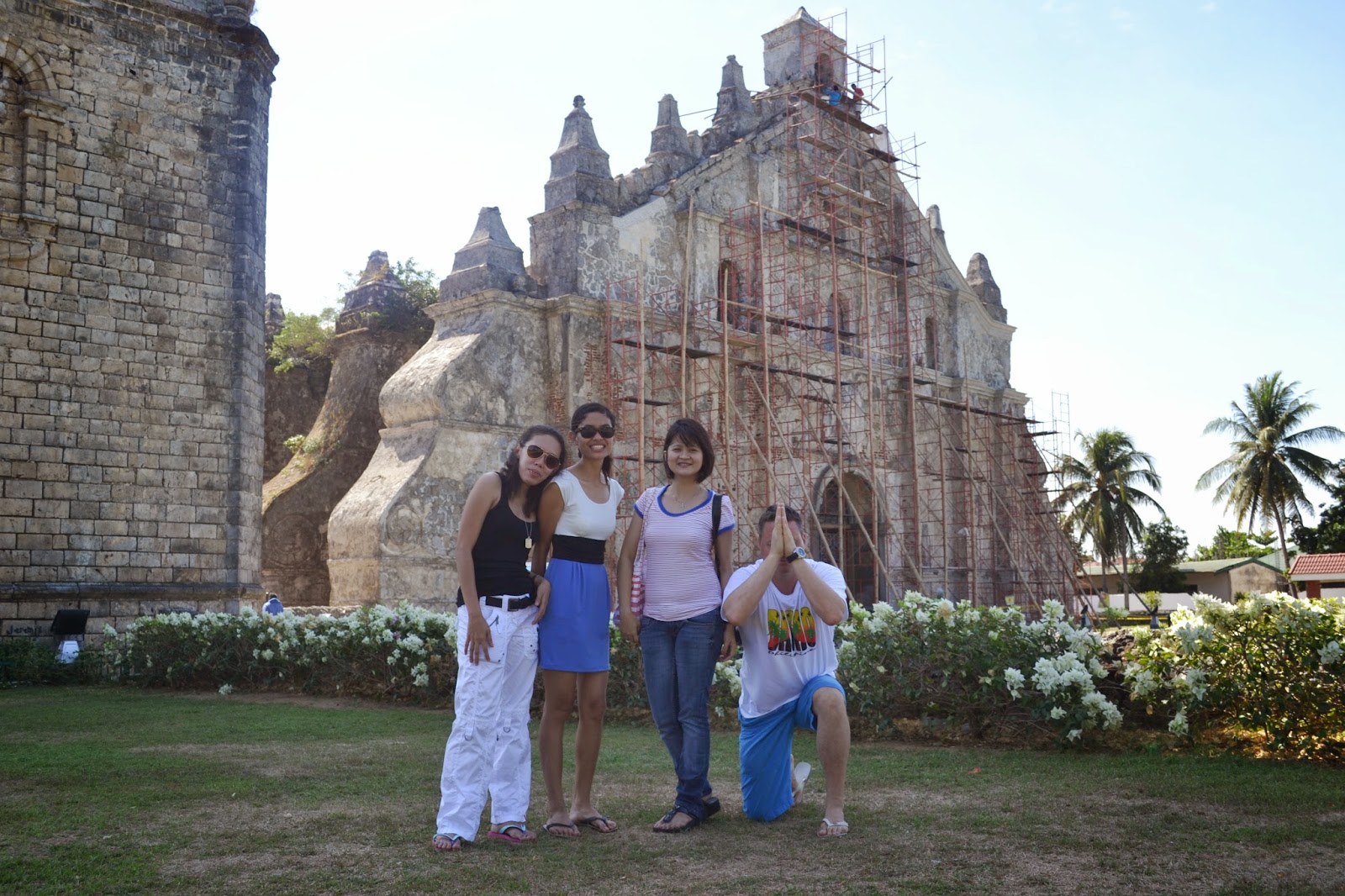
Completed in 1710, the church is famous for its distinct architecture highlighted by the enormous buttresses on the sides and back of the building. It is declared as a National Cultural Treasure by the Philippine government in 1973 and a UNESCO World Heritage Site under the collective group of Baroque Churches of the Philippines in 1993.

3. Marcos Mausoleum and Museum
The museum shows both memorabilia storage and the current resting place of Ferdinand Edralin Marcos. The large and solemn mausoleum contains the glass-encased coffin in which Marcos' embalmed body has been on public display since shortly after his remains were brought home in 1993. 

4. St. William's Cathedral & Sinking Bell Tower
The church is known for its Italian Renaissance design and it’s Sinking Bell Tower, which sinks into the ground at a rate of an inch a year. It also has an unusual two-storey façade, supported by two pairs of columns on each side of the arched entrance. The top of the façade holds a recessed niche that showcases the image of the city's patron saint, San Guillermo el Ermitaño. It has windows made from capiz with wrought iron screens. It is popularly known for its Sinking Bell Tower. 

5. Museo Ilocos Norte
The museum is nicknamed, “Gameng,” from the Iloco word meaning treasure. It symbolizes the wealth of Ilocos Norte. By imbuing the Ilocanos with pride in their local culture, it showcases the varied ethnicity and multi-faceted cultural heritage of a sturdy, hardworking people known for their industry, resourcefulness and loyalty. There is also a souvenir shop that offers native products and handicraft of Ilocos Norte, and a few books and other publications written about the province. 

6. Bacarra Church & Bell Tower Ruins
Bacarra Church is a Roman Catholic Church under the jurisdiction of the Roman Catholic Diocese of Laoag. The church was originally founded by the Augustinians, who dedicated it to St. Andrew. The church was declared a National Historical Landmark by the National Historical Commission of the Philippines, and a National Cultural Treasure by the National Museum of the Philippines. It is known for its centuries-old, domeless, leaning bell tower.
The Bacarra church is famous for its centuries-old, domeless or "beheaded" belfry known as Torre di Bacarra. The structure stands three stories and 50 metres (160 ft) high. The original bell tower, which is detached from the main church building and made of coral bricks, was erected in 1828.  However, periodic earthquakes from 1931 to 1971 caused the dome to start leaning. The entire dome was toppled by a 7.8-magnitude temblor on August 17, 1983. Restoration of the church was completed in 1984 at a cost of 3 million pesos. The tower is also known as the "Acrobatic Bell Tower of Bacarra”. 

7. Salt Making in Pasuquin
Salt making is also part of their livelihood. There are roadside stalls selling bags of salt and there are provincial buses that often stop at these stalls to purchase salt. The salt water is pumped and filtered by pipes from the beach to the burning furnace. The saltwater is cooked up until the the liquid is gone with only the salt crystals left. The crystals are poured over salt beds and left to dry by exposure to the sun. 

8. La Virgin Milagrosa Shrine of Badoc
Badoc houses the Sanctuary of the Miraculous Statue of the Blessed Virgin Mary, the La Virgen Milagrosa. History traces the life-sized statue to Nagasaki, Japan. It was sent floating in the sea by missionaries operating in secret in Japan (for fear of persecution during the Tokugawa Regime), along with the Miraculous Statue of the Black Nazarene (Sinait's Santo Cristo Milagroso). It was first found by local fishermen in the shores of Barangay Dadalaquiten, on the boundary between Sinait and Badoc, in the year 1620. Only fishermen from Sinait were able to move the Statue of the Black Nazarene. The fishermen from Badoc, unable to move the Black Nazarene, were able to move the La Virgen Milagrosa that came with it--which was, in turn, unable to be moved by the fishermen from Sinait. They took the statues to their respective towns, hence becoming their patron saints. Today The La Virgen Milagrosa is enshrined at the Badoc Church.

9. Cape Bojeador Lighthouse
Cape Bojeador Lighthouse, also known as Burgos Lighthouse, is a cultural heritage structure in Burgos, Ilocos Norte that was established during the Spanish Colonial period in the Philippines. It was first lit on March 30, 1892, and is set high on Vigia de Nagpartian Hill overlooking the scenic Cape Bojeador where early galleons used to sail by. After over 100 years, it still functions as a welcoming beacon to the international ships that enter the Philippine Archipelago from the north and guide them safely away from the rocky coast of the town.
The light marks the northwestern-most point in Luzon. The northeastern-most being Cape Engaño Lighthouse on Palaui Island,Santa Ana, Cagayan. The 66-foot-tall (20 m) octagonal stone tower, the most prominent structure in the vicinity, can be seen from as far away as Pasuquin town in the south and Bangui on the east on a clear day. Contrary to popular belief, it is not the highest-elevated or tallest lighthouse in the Philippines. But the highest elevated still original and active Spanish era lighthouse in the country. Corregidor Lighthouse is higher at over 600 feet (180 m), and among the Spanish Colonial lighthouses, the tower of Cape Melville Lighthouse is the tallest at 90 feet (27 m). In Mindoro Strait, the recently erected modern tower at the Apo Reef Light Station rises to a height of 110 feet (34 m).

10. Bangui Windmills
Bangui Wind Farm is a wind farm in Bangui, Ilocos Norte, Philippines. The wind farm uses 20 units of 70-metre (230 ft) high VestasV82 1.65 MW wind turbines, arranged on a single row stretching along a nine-kilometer shoreline off Bangui Bay, facing the West Philippine Sea.
Phase I of the NorthWind power project in Bangui Bay consists of 15 wind turbines, each capable of producing electricity up to a maximum capacity of 1.65 MW, for a total of 24.75 MW. The 15 on-shore turbines are spaced 326 metres (1,070 ft) apart, each 70 metres (230 ft) high, with 41 meters (135 ft) long blades, with a rotor diameter of 82 metres (269 ft) and a wind-swept area of 5,281 square metres (56,840 sq ft).

Phase II, was completed on August 2008, and added 5 more wind turbines with the same capacity, and brought the total capacity to 33 MW. All 20 turbines describe a graceful arc reflecting the shoreline of Bangui Bay, facing the West Philippine Sea.

12. Sarrat's Sta. Monica Church
The Santa Monica Parish Church, commonly known as the Sarrat Church, is a Roman Catholic parish church in the oblacion, Brgy. San Leandro in Sarrat, Ilocos Norte, Philippines. It was built in 1779 and was originally known as San Miguel Church. The Sta. Monica Church complex includes the convent connected to the church by an elevated three-level brick stairway.

The parish church of Sta. Monica is renowned as the largest church in the whole Ilocos Norte province, most especially the length of the nave. The church is made from red bricks built in Earthquake Baroque and Neoclassical architecture. Inside the sanctuary, the ceiling is a magnificent framework of wooden roof trusses, which number to around 480 logs of hardwood molave, 75% of which dates back to the 18th century.

12. Kapurpurawan Rock Formation
These are rock formations created by forces of the ocean on the rocky coast of Burgos, located just a few minutes further from the lighthouse.

Happy Travels!

Don't just keep this to yourself. SHARE!


Backpacking: Budget Friendly Travel in Baguio City, Philippines

Welcome to Travel+Experiment!   

Baguio city is popularly known as “Summer Capital” of the Philippines as the city is situated at higher altitude of approximately 1,540 meters (5,050 feet) in the Luzon tropical pine forests. The region is also known for its vast selection of mossy plants and orchids which is about 250 kilometers north of Manila (from 4-6 hours’ drive). During summer, tourists from all over the country flock to this city on spending their vacation and enjoy the cool climate weather. Local festivities such as the Panagbenga Festival also attract both local and foreign tourists. The Baguio Flower Festival is held every February which consist of street parades, colorful floats, costumes and native dance displays that has drawn huge crowds to Baguio every year.

Baguio City was established during the Americans occupation in 1900 for its strategic location near Ibaloi village known as Kafagway. It was the United States' only hill station in Asia. The name of the city is derived from the Ibaloi word bagiw meaning 'moss.' The Ibaloi is the indigenous language in the Benguet Region. On average, Baguio is at least eight degrees cooler than any place in the lowlands. This is also the favorite jump-off point for trekkers and mountaineers in search of adventure going up north in Sagada, Banaue and Kalinga.

Activities and attractions must see in Baguio.

Destination: Introducing Baguio City!
How to get there:

Visitors need to keep in mind that it takes at average 4-6 hour drive to get to Baguio. Major roads can get blocked by landslides and it is a safe precaution to drive safely.

By Car from Manila

Take the North Luzon Expressway (NLEX) from Quezon City until you reach Clark, then change on the new Subic-Clark-Tarlac Expressway (SCTEX) all the way north to Tarlac City, Tarlac. From there, take the old McArthur Highway until Rosario Junction, La Union. Motorists drive through the provinces of Bulacan, Pampanga, Tarlac and Pangasinan and La Union (if via Marcos Highway) or Benguet (if via Kennon Road). 

Main highways lead to Baguio City:

1. Kennon Road has an entry point at Rosario, La Union. It is the old road and has the shortest route that cars and buses usually take. Kennon Road is sometimes closed during the rainy season from June to October because of the danger of landslides. Buses and heavy vehicles are banned from Kennon; the route is only open for light vehicles.

2. Marcos Highway has two entry points at Rosario and Pugo, both in La Union, and is favored for its wider lanes with a more gradual uphill incline and is safer in the rainy season. It has spectacular vistas of the South China Sea on a clear day.

3. Naguilian Road is officially named Quirino Highway although no one really calls it that. Naguilian Road has an entry point at Bauang, La Union and usually taken by travelers coming from northern Luzon provinces and this route takes longer.

4. Halsema Road, passing through La Trinidad Valley - connects Benguet to Mountain Province (Sagada) and Ifugao (Banaue) and other places to the northeast.

5. Baguio-Nueva Vizcaya Road - connects Benguet to Aritao, Nueva Vizcaya, and is the newest access road coming from provinces to the east of the city and is a great alternative to Halsema Road.

By Bus from Manila

This is the most common and economical way to get to Baguio City from Metro Manila. Several bus lines ply the Metro Manila to Baguio route with terminals scattered across the metro. We took the Victory Liner Bus Pasay terminal going to Baguio. It has hourly bus service to Baguio from its Monumento Main terminal in Caloocan City, Cubao and Pasay terminals. Due to various stopovers along the way, it takes about 4-6 hrs to get to Baguio by bus. Cost is 455.00 pesos per person one way, air-conditioned. A non-stop deluxe bus service is also available for 750 pesos per person one way; water and snack are served during the trip. Semi-Deluxe buses are now included with one stop at Tarlac Shell station, costs around 650 pesos, no toilet inside the Bus.

How to get around:

By Jeepney

One thing advantageous for taking jeepney is if you are in a large group, you can rent the jeepney on a day tour trip to take you around the city and divide the expenses within the group. The minimum cost is 8.00 pesos per person.

By taxi

There are several taxis available around the city. Taxis can also be booked for a whole day tour at 1,800-2,000 pesos for an 8-9 hour tour of all the main attractions in and around town. Find a taxi at the Tourist Information Counter at the Victory Liner terminal or through your place of accommodation. Maximum capacity in each taxi is 5 persons (4 passengers, 1 driver).

By car

There are several cars for hire in Baguio and both self-drive and with driver options available. Rates for car rental Baguio companies can go by the hour, the day or by the week. Be ready to have your driver's license if you want to drive around the city.

I. Baguio Tour
1. Camp John Hay
It is one of the recreation facilities in Baguio City. It has 290 fully-furnished rooms in different quaint cottages, 18-hole golf course, horseback riding, camping sites, restaurants with its pine tree-lined roads and beautiful landscaping. Camp John Hay used to be the rest and recreational facility for employees of the military and Department of Defense of the United States. This 690-hectare property was turned over to the Philippine government in July 1, 1991.

2. Session Road
It is the main commercial hub and business central district of the city. Session Road is so named because it was the site of the Philippine Commission's first session. This is where you will find department stores, banks, movie houses, and bazaars. There are also some hotels, bakeries, restaurants, newspaper stands, bookstores, boutiques, cafes, and studios along Session Road.

3. Mines View Park
The park overlooks the mining town of Itogon, particularly the abandoned gold and copper mines of the Benguet Corporation and the view of the beautiful mountain scenery. There are also souvenir stores selling t-shirts, local food products and handicrafts items.

4. Philippine Military Academy
Philippine Military Academy is the school of the Armed Forces of the Philippines. Tourists are can view the PMA museum and their training ground where you will witness the marching precision of the Cadet Corps of the Armed Forces of The Philippines.

5. Burnham Park
It is a 32.84 hectare urban park, a man-made lake known as Burnham Lagoon where tourists can enjoy, sit back and relax with the charming environment and a numerous activities to love.

Burnham Park has 12 different facilities for recreation and relaxation that are available in the park:
  • the man-made lake with rowboats for hire that folks refer to as the Burnham Lagoon(100 pesos per hour)
  • the Children's Playground
  • the Skating Rink
  • the Rose Garden
  • the Orchidarium
  • Igorot Garden
  • Melvin Jones Grandstand
  • the Athletic Bowl
  • a Picnic Grove
  • the Japanese Peace Tower
  • Pine Trees of the World
  • Sunshine Park.

6. Strawberry Farm
Strawberry picking with the family is a unique experience you can enjoy.  It is best to try the fresh strawberry picking in the months of January to May in La Trinidad Valley, Benguet. The strawberries you pick fresh from the vines are more expensive compared to the harvested fruits within the farm. This is because the strawberry vine is so delicate that owners avoid the potential damages that the pickers can potentially harm the plant (they have their standard technique in picking).

Fresh Strawberry picking from the vines – 300-350 pesos per kilo
Fresh Strawberry harvested within the farm - 100-120 pesos per kilo
Strawberry Taho – 20-25 pesos per pc
Strawberry Ice Cream – 15-20 pesos per pc


7. Baguio Cathedral Church
It has its distinctive pink exterior, twin spires and stained glass windows make it a popular tourist attraction in Baguio.

8. Shopping at Public Market
Tourists visit in the city of pines won’t be completed without shopping in the public market. It has a wide array of inexpensive souvenir items, locally made products such as delicacies, handicrafts and other items for sale you name it.

9. The Kennon Road
Kennon Road (formerly, the Benguet Road) is a roadway in Benguet province connecting the mountain city of Baguio to the lowland town of Rosario in La Union province and is commonly known as "Zigzag Road". There are beautiful and scenic sites along Kennon Road such as the Bridal Veil Falls, Bued River gorge, Twin Peaks, Colorado Falls, a pedestrian suspension bridge, the sculptured limestone lion's head, and the spectacular view from the observation deck at the upper end of Kennon Road.

10. The Lion Head
This is the famous landmark in the Kennon Road. The Lion's Head measures 40 ft. (12 m) in height. The forerunner of the man-made Lion's Head was a "large rock" described to be "naturally shaped like a lion", which prior to 1972 was the landmark that tourists observe along Kennon Road towards Baguio City.

11. Wright Park
One of the interesting activities in the park is Horseback riding. It costs 300 pesos per hour plus a guide fee if you want to ride beyond the park. There are 200 available horses to choose and it features the rectangular man-made pool of water with tall pine trees and decorative street lights line both sides of the access road beside the pool. You can also pose for a souvenir photograph with the native Igorots dressed in their native attire or you may also wear the traditional Igorot costume with them for only 20 pesos per person. 

12. Botanical Garden
When visiting the Botanical Garden, you will find a group of Igorots at the main entrance who are dressed in their authentic native attire and regalia who will be more than happy to pose with visitors for a souvenir picture for a small amount of fee (below 100 pesos). Also known as the Igorot Village, the Botanical Garden features native huts typical of the type of Igorot dwellings found in the Cordilleras. The village is said to capture the ethnic spirit and cultural legacy of the Igorots. Igorot rituals and dances are sometimes conducted in the area.
Happy Travels!

Don't just keep this to yourself. SHARE!