Wednesday, April 1, 2015

Backpacking: Best Things to Do in Camiguin, Philippines

Welcome to Travel+Experiment!

After your adrenaline-pumping whitewater rafting adventure in Cagayan de Oro City, up next is the volcanic paradise island of Camiguin.

Camiguin is an island province of the Philippines located in the Bohol Sea, about 10 kilometers (6.2 mi) off the northern coast of Mindanao. It is politically part of the Northern Mindanao Region of the country and formerly a part of Misamis Oriental province.


Camiguin Activities & Attractions must see.

Destination: Introducing Camiguin!
How to Get to Camiguin from Cagayan de Oro (CDO) 

Via Balingoan
From Cagayan de Oro, take a taxi or van to Agora Bus Terminal. Fare should be around 200.00 pesos per person. From your hotel within the city center, you can take a taxi or motorela to Agora Bus Terminal. Take a Butuan-bound bus (143.00 pesos) or van from Agora Bus Terminal to Balingoan Port. Travel time is about 2-3 hours. If you're taking the bus, get off at Balingoan Bus Terminal and rent a tricycle or motorela (8.00 pesos) to the Balingoan Ferry Port. Alternatively, you can just walk towards the port. For vans, you can ask to be dropped off at Balingoan Port. RORO and ferry boats (170.00 pesos) leave hourly from Balingoan Port to Benoni Port (Camiguin). Early trip is 5:00 AM. Travel time takes about 1 hour.

Via Fastcraft in Macabalan Port
This is the expensive option but fastest way. From Cagayan de Oro Airport, take a taxi or van to Macabalan Port in Cagayan de Oro City. From your hotel within the city center, you can rent a motorela or take a jeepney (with "Pier" sign) to Macabalan Port. Take the Ocean Jet ferry from Macabalan Port to Benoni Port (Camiguin). Fare is 550.00 pesos per person and travel time is about 2 hours. Take note that Ocean Jet has only one trip per day (8:30 AM). We took this option from Camiguin to Cagayan de Oro (4:00 PM).
4 Days 3 Nights Cagayan de Oro with Camiguin Package Tour - usually this package tour would cost around less than 5,000 pesos.

Day 1 – Pick-up from Cagayan de Oro Laguindingan Airport, drop-off to hotel in the city. Standard check-in time is at 02:00 PM. If reaching early, it will be optional for the group to go to Water Rafting, Dahilayan in Bukidnon for the zip line activity or visit Del Monte Plantation. Overnight in Cagayan de Oro Hotel.

Day 2 – Drive to Balingoan port, located 1hour away from Cagayan de Oro City. Take 1 hour ferry from Balingoan to Benoni port in Camiguin. Upon reaching, proceed to do the Camiguin Countryside Tour. Spots to visit when in Camiguin, during Camiguin Tour: Island hopping, Waterfalls, Sunken Cemetery, Church Ruins, Soda Water Pool, Sto. Nino Cold Spring, Ardent Hot spring, Station of the Cross.  Overnight in one of the Camiguin resorts.

Day 3 – Time to go Island Hopping in Camiguin. The most popular spot is White Island, which is a sandbar which may be reached through a pumpboat (outrigger). Those who are trying to catch a trip back to Cagayan De Oro must leave early. However, it is suggested that pax allocate an entire day so they can also visit Mantigue Island and the Giant Clam Sanctuary before heading back to Cagayan de Oro. Depending on flight details on Day 4, the group can decide whether to spend another night in Camiguin or head to Cagayan de Oro in the afternoon.

Day 4 – Departure from Cagayan de Oro 


I. Camiguin Tour
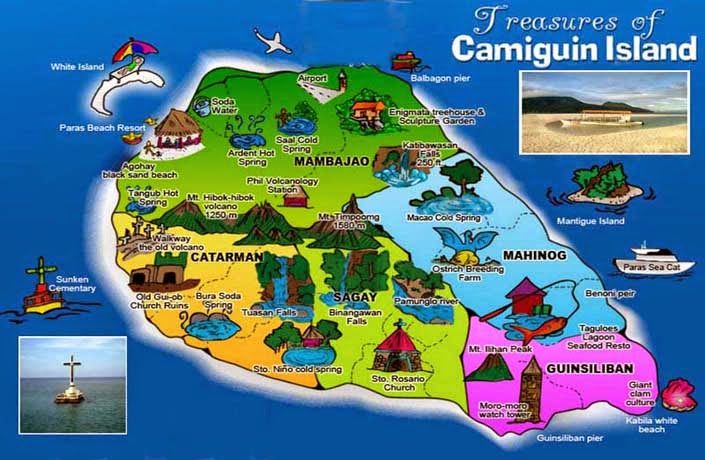
Camiguin Island is a pearl-shaped island with an area of approximately 238 km2 (92 sq mi). The island measures about 23 kilometers (14 mi) at its longest and 14.5 kilometers (9.0 mi) at its widest breadth. The island is mountainous with the highest elevation reaching over 5,000 ft (1,500 m). It is encircled by a national road with a total length of about 64 kilometers (40 mi). As of the August 1, 2007 census, the province has a 5th class income classification with a population of 81,293.

History: Volcanic activity from 1871 to 1875
On February 16, 1871, earthquakes began to be felt on the island, which increase in severity until April 30 when a volcanic fissure opened up 400 yards southwest of the village of Catarman, northwest of Hibok-Hibok Volcano. Mt. Vulcan was born and continued erupting pouring lava into the sea at the same time gaining in height and width. In 1875, theChallenger expedition visited the area and described the mountain as a dome, 1,950 ft (590 m) in height, without any crater, but still smoking and incandescent at the top.

The town of Catarman was destroyed and portion of the town sank beneath the sea. The settlement moved to where the town center is presently located and today, all that remains of old Catarman are the ruins of the ancient Spanish church, a convent and a bell tower.

1) White Islands

Located just a few kilometers off the coast are the two islands of Camiguin.
  • White Island is accessed from Agoho which is about 5 km (3.1 mi) west of the town of Mambajao
  • Mantigue Island can be reached from Mahinog about 14 kilometres (8.7 mi) south of Mambajao
2) Lanzones Festival

Lanzones Festival is held every third week of October and it is a four day grand celebration of the lanzones fruit. The most important livelihood in Camiguin is lanzones. It is when a lot of tourists come to witness the joyous Lanzones festival.Lanzones is one of the major fruit producers in the Philippines. Lanzones is a tropical fruit that grows extravagantly on the north-central coast of Mindanao. Lanzones has a pale brown skin and sweet translucent flesh. It is said that the sweetestlanzones in the Philippines comes from Camiguin. The town of Mambajao in Camiguin celebrated its annual festival calledLanzones Festival together with its harvest in the month of October.

3) Churches

  • Old Catarman Church Ruins: The church of the Old Catarman town was destroyed and partly submerged by volcanic debris during the eruption and formation of Mt. Vulcan from 1871 to 1875. Also known as Gui-ob Church, only the ruins of the church and bell tower remains of the old town. An unsightly modern white lighthouse was recently erected close to the bell tower
  • Baylao Church: The Church located in Brgy. Baylao in Mambajao is claimed to be miraculous attributed to saving many lives during the last volcanic eruption of Hibok-hibok
  • Santo Rosario Church: The Santo Rosario Church in the municipality of Sagay was built in 1882 using coral stones. The church is decorated with driftwood chandeliers, the sawali (woven bamboo skin) walls, the ornamental plants at the entrance, bamboo columns, and other environment-friendly materials.
4) Springs
  • Ardent Hot Spring. At the foot of Hibok-Hibok Volcano bubble the mineral pools of Ardent Hot Springs. Wisps of steam can be seen rising from the running waters heat by the cauldron of the mountain, the most recently active of the seven volcanoes on the island. Entrance fee is also at 30 pesos.
  • Sto. NiƱo Cold Springs and Bura Natural Soda Water Swimming Pool in Catarman are other popular places to get a relaxing dip on the island. Entrance fee in Bura Soda Water Spring is 30 pesos. The pool was divided into two areas, obviously for the swimmers and non-swimmers.
5) Sunken Cemetery

During the volcanic birth of Mt. Vulcan that lasted from 1871 to about 1875, some areas in the town of Bonbon subsided, sinking the cemetery of the town to below sea level. The place is commemorated by a huge cross erected in 1982. 
6) Waterfalls
  • Katibawasan Falls. Located 5 km (3.1 mi) southeast of Mambajao, the Katibawasan Falls cascades 250 ft (76 m) down to a pool surrounded by orchids and ferns. An invigorating dip on the pool is popular especially on warmer days and several hiking trails are within the park. This is also the favorite jump-off point for trekkers and mountaineers in search of adventure on the slopes of Mt. Timpoong.
Admission Fee
    • Adult - 20 pesos
    • Children - 5 pesos
    • Students - 10 pesos

  • Tuasan Falls is located 6 km (3.7 mi) northeast of Catarman. Getting to the falls entails a very scenic hike passing through the Barrio of Mainit, Catarman and along the rocky river bed. The pool below the waterfalls is deep and clear. The surrounding scenery is unspoiled and perfect for a peaceful picnic, the only sounds around you is that of the tumbling falls and running water. There is no entrance fee but you have to hire a tour guide to take you the waterfalls. The water is very clear and clean.
7) Walkway to the Old Volcano and Station of the Cross
It is an 8 kilometer path with 14 human-sized stations situated at Mt. Vulcan in Barangay Bonbon, Catarman. The spot is actually one of the famous tourist destinations in Camiguin Island especially during the Lenten Season as it serves as a pilgrimage site to Roman Catholic devotees.
This photo was taken in White Island Camiguin (October 2009) with the boats in the background.

Happy Travels!

 Don't just keep this to yourself. SHARE!


Backpacking: Must See Sights in Cagayan De Oro, Philippines

Welcome to Travel+Experiment!   

The city is known as the “City of Golden Friendship” because of the innate friendliness of its people. It is the capital city of Misamis Oriental. Cagayan de Oro’s much talked-about whitewater rafting and river trekking make it the premier destination of the city. The Cagayan de Oro River is famed for challenging rapids and which they say the wild river helps you discover your inner strength and endurance.

Cagayan De Oro activities & Attractions must see.
Destination: Introducing Cagayan De Oro City!
I. Cagayan Tour 
You can avail to any group tour package when planning to visit Cagayan. Hotel accommodation is already part of the package tour which is also very accessible and round trip transfers from Laguindingan International Airport to any hotel in Cagayan De Oro city.

4 Days 3 Nights Cagayan De Oro with Camiguin Package Tour - usually this package tour would cost around less than 5,000 pesos. Take note we got this price way back 2009.

Day 1 – Pick-up from Cagayan De Oro Laguindingan Airport, drop-off to hotel in the city. Standard check-in time is at 2:00 PM. If reaching early, it will be optional for the group to go to Water Rafting, Dahilayan in Bukidnon for the zip line activity or visit Del Monte Plantation. Overnight in Cagayan De Oro Hotel

Day 2 – Drive to Balingoan port, located 1hour away from Cagayan de Oro City. Take 1 hour ferry from Balingoan to Benoni port in Camiguin. Upon reaching, proceed to do the Camiguin Countryside Tour. Spots to visit when in Camiguin, during Camiguin Tour: Island hopping, Waterfalls, Sunken Cemetery, Church Ruins, Soda Water Pool, Sto. Nino Cold Spring, Ardent Hot spring, Station of the Cross.  Overnight in one of the Camiguin resorts.


Day 3 – Time to go Island Hopping in Camiguin. The most popular spot is White Island, which is a sandbar which may be reached through a pumpboat (outrigger). Those who are trying to catch a trip back to Cagayan De Oro must leave early. However, it is suggested that pax allocate an entire day so they can also visit Mantigue Island and the Giant Clam Sanctuary before heading back to Cagayan de Oro. Depending on flight details on Day 4, the group can decide whether to spend another night in Camiguin or head to Cagayan De Oro in the afternoon.

Day 4 – Departure from Cagayan De Oro 

1. White Water Rafting
Experience an adventure in the natural, wild, and rugged countryside. Shoot the rapids and wrestle the waves and whirlpools down the Cagayan de Oro River. A minimum of 6 persons can enjoy a maximum of four hours with 14 rapids and friendly whirlpools between the huge mountain ranges of Bukidnon. Among the rapids you will encounter, the hardest to conquer of all is the “Kiss the Walls.” Day tour includes jeepney transfers from hotel to jump off point and vice versa, use of raft, life vest, helmet, paddle, guides, and entrance fees. White Water Rafting - 700 pesos/person (min of 5 persons. You'll have to pay 875 pesos/person if you are only 4. Includes transportation to/from the site).

Important Reminders:
  • Guests are to sign waiver forms before the tour
  • Guests must be physically fit to trek and to paddle
  • Guests are to bring own food, drinks and snacks in water light containers during the tours
  • Guests should bring a change of clothes as they can expect to get dirty and wet
  • Guests must wear proper trekking shoes for Canopy and swim suits for Rafting
  • Guests with sensitive skin must bring protective lotion

2. Dahilayan Adventure Park: Zipline!

Dahilayan Adventure Park boasts of two 840m Ziplines with a drop of 100 meters. Zipriders are transported via 4WD Safari Cruiser to a launch tower at 4500′ ASL. Basically they have three courses for ziplines depending on the length. The Zipline Bundle includes the three zip-rides and is offered to all adults who wish to take the complete course. They have the shortest which is 150 meters, pretty well suited for children, 320 meters, and the longest course which is around 840 meters. All rides for 600 pesos.

3. Visit Del Monte Plantation in Manolo Fortich Buidnon
Maximize your time in Bukidnon. After adrenalin-pumping activities at Dahilayan, head on over to one of the world’s largest pineapple plantations. Bukidnon is dubbed as the highland paradise in the heart of Mindanao. There are many destinations to visit and enjoy in Bukidnon, including the Mangima Canyon, Atugan Bridge, Monastery of Transfiguration, Stone Marker of Yoshito’s Grave, Kaamulan Park, Pine Hills Hotel, and the Del Monte Pineapple Plantation and their country club with an astounding view of the Mount Kitanglad range.

Tour Rates (computed per person/prices are in Philippine Peso):

Person in Group: Regular rate (2012)
·         2 persons = 3,500.00 pesos
·         3-4 persons = 2,800.00 pesos
·         5-6 persons = 2,300.00 pesos
·         7-11 persons = 2,100.00 pesos
·         12 or more = 2,000.00 pesos

4.) Tsada Kagay-an Half Day City Tour
Tsada Kagay-an also known as the TK4 Tour is the prime mover of the city tour in Cagayan de Oro. For only 599.00 pesos per head, you will be touring around the city for a maximum of 4 hours.  You'll be learning the historical views of the city while enjoying the scene and experiencing the hospitality and friendly approaches of the Kagay-anons. You'll be traveling the city on an air-conditioned Coaster with the services of a Tour Coordinator and Department of Tourism accredited Tour Guide. Entrance and Admission fees are actually included when you avail the tour. Plus, don't be surprised when the Tour Guide and/or Tour Coordinator will give you a pastel (a soft-bunned pastry with sweet caramel inside) and 1 bottled-water for free.
Inclusions:
  • Plaza Divisoria (the center of trade and commerce in Cagayan de Oro) which most of the businesses are found and where the Freemasonry Centennial Marker is located
  • Gaston Park and the St. Augustine Cathedral. There, you'll be amazed of the centennial old gothic inspired cathedral which houses the seat of the Archdiocese of Region 10
  • You'll be walking on a 20 steps going to the only leaning tower of Cagayan de Oro known as the City Museum. The Museum is actually leaning on the right same as that of the Leaning Tower of Pisa. What to expect in the Museum? The history of Cagayan de Oro and the people who carefully furnish the city
  • Next is the Pasalubong center
  • You'll be traversing to the longest street of the City known as the J.R. Borja Street
  • The Cogon Market! It houses one of the best Hot Chocolate in the Region called the "Sikwate" or "Tsokolate".
  • The TK4 also includes Lim Ketkai Center which houses the first Starbucks in Mindanao and first McDonalds outside Metro Manila, La Castilla Museum, Museo de Oro, Gen. MacArthur Marker which houses the largest replica of the cap of General Douglas MacArthur and the Plaza De Los Heroes.

II. Camiguin Tour 

The information on Camiguin tour is on a separate Camiguin post. You may click on Backpacking: Camiguin Philippines.

This was taken during our break pause (October 2009) before our water rafting in Cagayan De Oro River in the background.

Happy Travels!

Don't just keep this to yourself. SHARE!


Backpacking: Top Tourist Attractions in Bohol, Philippines

Welcome to Travel+Experiment!

The isolated island of Bohol is quaint unique in comparison to the bustling city life of Metro Manila or Cebu City. There are two parts of Bohol, one is the main island in which Tagbilaran is the capital city and second is Panglao Island. Tagbilaran houses the main transportation hub that connects to Cebu, Manila, and other cities while Panglao is the resort destination adjacent to Tagbilaran city.

Get the full vacation experience and discover the fascinating island of Bohol.

Bohol activities & Attractions must see.

Destination: Introducing Bohol Island!
If you plan your travel on your own, these insights below may help you figure out what to do and expect during your tour. My experience which highly I recommend for tourists who want to discover the exquisiteness of Bohol Island in accordance of their length of stay and preference.

There are a lot of inexpensive package tours with accommodations. Packages Including hotel stay and tours usually would cost around 6,000 pesos or more with airport or port to port transfers. If you are traveling in a group, it is advisable that you consolidate and divide the expenses.

Inclusions:
  • 3 days & 2 nights (3d/2n) Accommodation
  • Port-Hotel-Port/airport transfers
  • Daily Breakfast
  • Tour (based on prearranged/customized travel plan)
  • Air-conditioned vehicle with driver and gas for the Tour
  • Driving Guide
  • Buffet Lunch while cruising Loboc River
  • All Entrance Fees and Permits
 

I. Panglao Island Tour

A. Dauis Church
Dauis Church, or the Church of Our Lady Assumption, is one of the oldest stone churches in the Philippines. Here you can see historical and religious artifacts dating back to the Spanish colonial era.

B. Hinagdanan Cave

The Hinagdanan Cave is Bohol's most famous and visited cave. It is a naturally lighted cavern with a deep lagoon and many large stalactites and stalagmites. The cave is lit by sunlight which filters through holes in the ceiling.

C. Bohol Bee Farm

The Bohol Bee Farm promotes a healthy lifestyle with its organic food and products especially honey. They also show you several farm activities like basket weaving, organic farming and bee culture. Bohol Bee Farm also provides room accommodations to stay-in visitors.

D. Island Hopping/Dolphin & Whale Watching Tour

Inclusions: Snorkel gadgets are not included.
  • Tour Driver
  • Dolphin Spotter
Pump boat Rental Rates:
  • 1-4 person/s - 1,800 pesos
  • 5-10 persons - 2,000 pesos
  • 11-15 persons - 2,500 pesos

1.) Dolphin & Whale Watching 

Watch the playful dolphins and endangered whales of Bohol. With the help of trained spotters and guides, who used to be hunters of these sea dolphins and whales before the practice was banned; you can experience the beauty and artistry of these magnificent sea creatures.

2.) Balicasag Island Snorkeling

Explore the beauty of Bohol's vast and colorful marine life. The island has one of the richest tropical fish habitats in the world. You can see for yourself the numerous tropical fishes and corals in their undisturbed environment.

3.) Virgin Island


After a day of watching dolphins, diving and snorkeling, you might want to visit the Pungtud Island - also known as Virgin Island, a small islet famous for its white sands and untouched natural environment. You can take a dip in its clear blue waters or just bask in the sun.

II. Bohol Countryside Tour

1.) Blood Compact Shrine

The Blood Compact Shrine commemorates the first treaty of friendship between the white and brown races. Spanish conquistador Miguel Lopez de Legazpi and local chieftain Rajah Sikatuna sealed the treaty by drinking wine mixed with blood, thus it was called the "Blood Compact" or "Sandugo."

2.) Baclayon Church

Built in the 16th century, shortly after the arrival of the Spaniards, Baclayon Church is one of the oldest stone churches in the Philippines. Religious relics and cultural artifacts can be seen in this historical landmark.

3.) Python Sanctuary
Do you know that the largest python in captivity can be found in Bohol? A 25-feet long python named Prony can be found in the town of Albur. Prony is considered as a harmless pet by its owner and is fed once a month.

4.) Tarsier Conservation Center


The tarsier is widely considered as the world's smallest primate and is also deemed as an endangered species. With its large eyes, the tarsier hunts small insects for food and climbs from tree to tree. 

5.) Loboc River Cruise and Floating Restaurant

Be mystified and captivated by the enchanting Loboc River Cruise. Take a ride on one of the floating restaurants and treat yourself to an afternoon of relaxation and enjoyment, along with a sumptuous lunch and traditional local music. The trip is about 45-minute cruise on Loboc River while having a delightful lunch buffet on a floating restaurant.

6.) Batuan Shiphaus
The Batuan Shiphaus is a house that was designed to look like a real ship. The owner of this house is a ship captain. The house has different cabins like that of a real ship. Even the employees are dressed like the crew of a ship.

7.) Chocolate Hills
The world-famous Chocolate Hills is a must-see when visiting Bohol. Thousands of green and brown hillocks dot the landscape as far as the eyes can see, truly a natural wonder that can only be seen in Bohol.
 
8.) Gift Shop


After a tiresome but enjoyable day, a good way to cap it off is to buy souvenirs and local items at Aproniana Souvenir Shop. Buy some gifts to bring home to your friends and family, or simply as a souvenir or remembrance of your Bohol vacation.

This photo was taken during our January 2006 Bohol trip; Chocolate Hills as background.

Happy Travels!

 
Don't just keep this to yourself. SHARE!